A Rainy Afternoon Question Trail for Two
A rainy afternoon question trail for two turns an ordinary object into a relaxed shared exploration, with simple ways to choose a subject and follow a question.
Rain taps the window while two mugs cool on the table. A rainy afternoon question trail for two can begin with one of them: choose an ordinary object, trade questions about it, then follow one question together. The point is not to solve the object. It is to give curiosity a pleasant direction and make room for both people to shape it.
The best version depends on the pair. Two people who like a loose conversation need a different trail from a restless child, a detail-loving friend, or companions who would rather make something than talk. Start by choosing the format that fits the afternoon you actually have.
Choose the trail that suits your company
For two people who want a quiet conversation: Use an object already within reach, such as a key, spoon, houseplant, or old envelope. Sit somewhere comfortable and let questions arrive without setting a finish line. This suits a low-energy afternoon because the object supplies a shared focus without requiring preparation.
For a curious child and an adult: Pick something the child can handle safely and describe in their own words, perhaps a pinecone, mitten, or toy. Keep turns short, and let drawing or pointing count as a question. This fits a pair with different vocabularies because observation does not depend on knowing specialist terms.
For friends who enjoy making things: Choose an object with a visible shape or mechanism, like a paper clip, clothespin, or cardboard box. Follow a question by sketching, arranging, or building a small model from scrap paper. This gives hands something to do while the conversation wanders.
For a pair that tends to debate: Choose an object with several plausible stories, such as a worn button or a folded map. Agree to collect possibilities before favoring one. This suits lively talkers because it turns disagreement into more questions rather than a contest over who can answer first.
Pick the mood before you pick the object; that small decision makes the activity feel welcoming rather than assigned.
Choose an object with enough to notice
A useful object is ordinary, available, and easy to look at from more than one angle. It need not be mysterious or rare. Familiarity can help: a chipped bowl, raincoat zipper, house key, or tea bag has details people usually pass over.
Set aside objects that are fragile, sharp, private, or likely to start an argument unrelated to the activity. If you are exploring a household item, follow its label or maker’s directions wherever handling or use matters. The trail can be entirely observational; nobody needs to take anything apart.
Before settling on an object, ask each other:
- Can we both see or handle it comfortably?
- Does it have details we can describe without guessing?
- Can either of us think of questions that interest us?
- Will we be content to leave some questions unanswered?
If one person cannot see a detail clearly, rotate the object or describe it aloud. Shared attention should not depend on having the same vantage point.
Set a gentle rhythm for taking turns
Agree on a few simple boundaries: one question at a time, no requirement to answer immediately, and permission to pass. Then take turns offering questions. A question may ask about appearance, use, material, history, or an imagined possibility, but neither person has to know which kind it is.
For instance, with a spoon, one person might ask, “Why is the handle curved?” The other could respond with another question: “Would it feel different if it were flat?” That keeps the exchange open without making either person responsible for producing a polished explanation.
After several turns, pause and each name the question they would most like to pursue. Compare the choices and select one together. If the favorites differ, look for a shared thread: a question about the spoon’s shape might connect to a question about how it feels in the hand.
Keep a scrap of paper nearby if a good question appears while another is being followed. Write down a few words, then return to it later rather than letting it pull the conversation in several directions at once.
Follow one question with what you have
The chosen question sets the pace. If it asks how an object is made, inspect visible seams, marks, or joins and describe what you can actually see. If it asks why a shape might be useful, each person can suggest a possibility and point to the feature that prompted it.
Use ordinary resources: a lamp to change the angle of the light, a magnifying glass if one is already handy, scrap paper for a sketch, or a phone camera to capture a close view. These tools can reveal details or preserve a comparison. They do not have to turn the afternoon into a formal investigation.
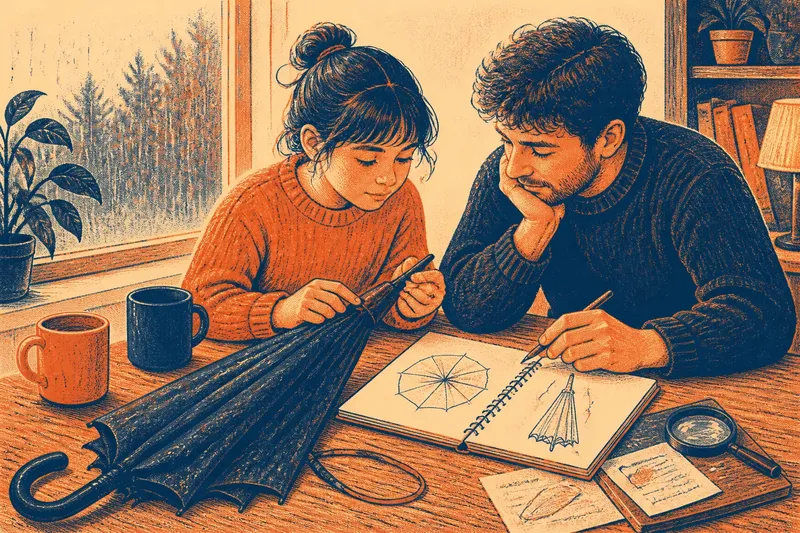
Imagine two people choose a rain-soaked umbrella by the door and ask why its fabric forms little ridges when folded. They look at the open and closed umbrella, sketch the fabric’s path, and wonder whether the ridges follow the supporting ribs. The useful result is not a claim about every umbrella; it is a clearer question they can see how to explore next.
When a question cannot be settled by looking, say what additional clue might help. Perhaps the object’s maker, packaging, or a knowledgeable person could clarify it another time. For today, distinguishing an observation from a guess is already progress.
When should the trail change direction?
What if neither person has a question?
Take turns naming a detail: a color shift, a worn edge, a seam, or an unusual sound when the object is moved. Turn each detail into a question, such as “What might have made this mark?” One concrete observation often gives the next turn somewhere to begin.
What if one person does most of the talking?
Try a quiet thinking pause, then let the less talkative person choose which question to follow. They can answer by pointing, sketching, or asking a question back. The aim is shared attention, not equal quantities of speech.
What if the chosen question has no clear answer?
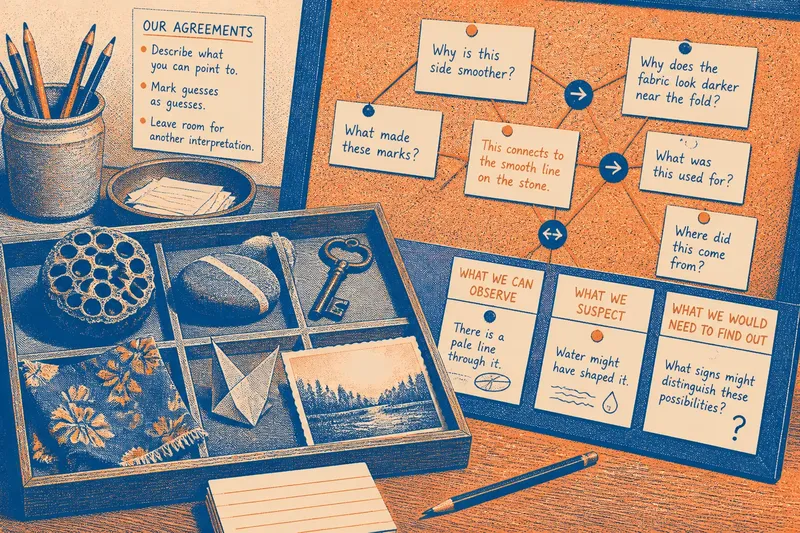
Separate what you can observe from what you are inferring, then ask what evidence would help distinguish the possibilities. If that evidence is unavailable, keep the question open or choose a nearby question that can be explored with the object in front of you.
What if one person wants to stop?
Stop without requiring a final answer. Each person can name one detail they had not noticed before, or simply put the object back and leave the rest for another day. An easy ending helps the activity stay inviting.
End with a small trace of the conversation
Before putting the object away, each person can share one observation, one new question, or one connection they did not expect. If you want a memento, make a tiny question map: write the starting question in the middle and add the ideas that branched from it. A few words are enough.
Keep the record only if it adds pleasure. The point is not to build an archive or prove that the afternoon produced a discovery. It is to leave a small opening for the next conversation: a detail to notice again, an idea to check later, or a new object to place on the table.
For a rainy afternoon question trail for two, choose the lightest format that fits the pair, let both people steer, and stop while curiosity still feels welcome. The next trail can begin with whatever ordinary object catches someone’s eye.