The First-Answer Trap: Why a Quick Explanation Can Close a Question Too Soon
The first-answer trap turns a plausible guess into a stopping point. Learn a simple pause-and-check habit that keeps shared questions open to better explanations.
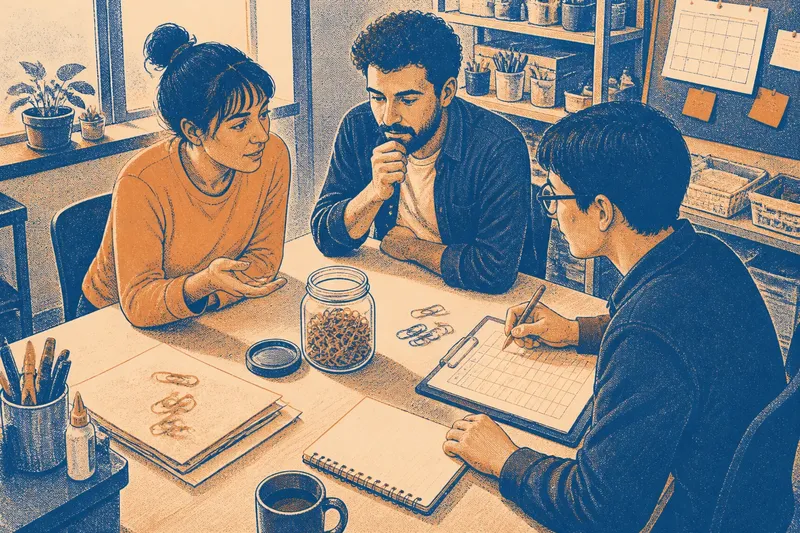
A jar of paper clips sits open on the desk, and by midafternoon its contents look lower than they did that morning. “Someone took a handful,” says Mara. Her teammate Eli nods, already turning back to the spreadsheet. The explanation fits. It also risks ending a small investigation before anyone has checked what happened.
The first-answer trap is the moment a plausible explanation quietly becomes the accepted one. In a group, that can happen even faster: one person offers a neat story, another agrees, and the room moves on. A pause-and-check habit does not require suspicion toward every idea. It simply gives the first answer a different status: useful starting guess, not settled view.
A plausible story can feel like a finished answer
People reach for explanations because they help make a confusing scene legible. A missing object, a changed result, or a surprising comment leaves a gap; a familiar cause fills it. That mental shortcut is often helpful. The trouble begins when familiarity is mistaken for evidence.
In a shared conversation, agreement can strengthen that mistake. A teammate may nod because the explanation sounds reasonable, because they do not want to slow the meeting, or because they assume someone else has checked. Silence then looks like confirmation, though nobody has actually compared the idea with what is known.
The first answer can also shape what the group notices next. Once “someone took the clips” is on the table, people may look for a person to blame rather than consider whether the jar was moved or refilled. The question has not disappeared; it has been narrowed around the first story.
A useful distinction is between a claim and its support. “Someone took a handful” is a claim. “The jar looked fuller earlier” is an observation, and even that observation may need checking: who saw it, and when? Keeping those layers separate makes it easier to revise the explanation without treating revision as a personal defeat.
The team separates what it saw from what it inferred
Imagine Mara and Eli work in a small community workshop. They keep paper clips in an open jar beside the shared calendar. After lunch, Mara notices that the jar appears less full and says a volunteer may have taken some home. The comment lands as an explanation, although the team has no direct evidence of that.
Eli pauses before agreeing. Instead of challenging Mara’s judgment, he asks what they know for sure. Mara remembers seeing clips near the top of the jar that morning. Eli says he did not notice the level then. They agree that the jar looks lower now, but they cannot establish how much it held earlier or whether the same person was looking from the same angle.
This small exchange changes the task. The team is no longer trying to identify who took the clips; it is trying to understand why the jar appears lower. That is a narrower, fairer question, and it does not smuggle an accusation into the search.
They list a few possibilities aloud: someone used clips during a project, the jar was moved, or the level looked different because it was viewed from above rather than from the side. These are possibilities, not a parade of equally likely theories. The group does not need to generate every imaginable cause. It needs enough alternatives to loosen the grip of its first one.
Then Mara checks the workshop table. A stack of sign-in sheets and a few loose clips are there; a volunteer has been assembling packets for a community event. That makes ordinary use plausible, but it does not establish who used the jar or exactly when. Eli checks the supply shelf and sees another open container that could have been moved beside the calendar earlier.
The team now has a better account of what remains uncertain. Clips may have been used for the packets, the jar may have been relocated, and the morning comparison may be unreliable. They do not turn those clues into a confident story about a particular person. Instead, they refill the jar from the supply shelf and agree to keep it in the same spot for the next work session.
Later, the jar still looks lower after packet-making. That result makes use during the activity a reasonable explanation for the change. It does not prove precisely how many clips were used or rule out every other possibility. The useful result is modest: the team has an explanation tied to something observable, and it has avoided treating an early suspicion as fact.
A pause-and-check routine keeps the question open
The routine in this invented situation is deliberately small. It is not a formal investigation and does not demand a long meeting. Its value comes from giving a group a shared way to hold an idea lightly while deciding what, if anything, is worth checking.
- Name the first explanation. Say, “Our current guess is that the clips were used for the packets.” Calling it a guess makes its status clear without dismissing it.
- State the observation separately. Describe what prompted the guess: “The jar looks less full now.” Avoid adding an unverified cause to the observation.
- Ask what is not yet known. In this case, the team did not know the jar’s earlier level, whether it had moved, or when the clips were used. The gap often points to the next useful question.
- Consider one or two alternatives. Look for possibilities that fit the same observation, such as a changed viewpoint or routine use. The aim is to check the first explanation against alternatives, not to build an endless list.
- Choose a proportionate check. Compare the jar’s location, look at the work area, or observe what happens during the next session. A check should address the uncertainty without creating a bigger burden than the question deserves.
- Say what the check can and cannot establish. Seeing clips used for packets supports that explanation for the later change; it cannot establish every detail of what happened earlier.
- Update the wording. Move from “Someone took them” to “They may have been used during packet-making.” If the evidence stays thin, keep the uncertainty visible instead of polishing a guess into certainty.
Not every passing question needs all seven moves. For a low-stakes puzzle, a brief pause and one check may be enough. When an explanation could unfairly implicate someone or influence a consequential decision, the group should be more careful about evidence and seek appropriate guidance for the situation.
Questions that help a group check its first answer?
How can a group question an idea without sounding dismissive?
Ask about the basis for the idea rather than judging the person who offered it: “What did we notice that points that way?” Then invite another possibility before deciding what to check. That keeps curiosity directed at the explanation, not the speaker.
How many alternative explanations should people consider?
Usually, one or two plausible alternatives are enough to show that the first story is not the only one. Generating a long catalogue can distract from the evidence and make a simple question feel burdensome. Add another possibility only if the current options leave an important observation unexplained.
What if the first explanation still seems most likely?
Keep it as the leading explanation while naming the observation that supports it and the uncertainty that remains. A considered view can favor one account without pretending it has been proved. The next useful move may be to check one detail or simply leave the question open.
When is a quick answer good enough?
A quick answer may be sufficient when the stakes are low, the explanation fits what is directly observable, and further checking would not change a meaningful decision. Even then, wording such as “probably” or “our best guess” can mark the difference between a convenient answer and a firm conclusion.
Good checking has a stopping point
A pause is useful when it leads to a better question or a relevant check. It becomes a detour if the group keeps multiplying possibilities without learning anything new. In the workshop, the team’s next observation gave it enough reason to favor routine use as an explanation for the later change; it did not need to reconstruct every movement of the jar.
Groups can make that boundary explicit. Before checking, ask what observation would make the explanation more plausible, what might weaken it, and whether either result would change what the group does. If no possible answer would affect a decision, a deeper inquiry may not be worth the attention.
This is also why uncertainty should be stated in ordinary language. “We saw clips being used during packet-making” is more informative than “the mystery is solved.” The first sentence preserves what was observed; the second can imply a level of certainty the group does not have.
It helps to notice whose interpretation is setting the direction, too. A confident voice can become the default, while a quieter person may hold a relevant detail. Asking each person what they directly noticed—not what they think the group wants to hear—can widen the shared view without requiring everyone to agree.
A considered view stays open to revision
The first-answer trap is not a failure of intelligence. It is a familiar shortcut that becomes harder to see when a story is tidy, the room is busy, or everyone is ready to move on. A brief pause gives the group room to distinguish what happened from what it assumes happened.
For the paper-clip jar, that meant replacing an unsupported suspicion with a modest explanation grounded in the team’s later observation. The useful habit was not “never trust the first idea.” It was to let the idea earn its place by asking what it explains, what remains unknown, and what small check could sharpen the picture.
The next time a quick explanation settles a shared question, try a sentence that leaves the door open: “That could be it; what have we actually observed?” The answer may survive the check, change shape, or remain uncertain. Any of those is more useful than mistaking the first plausible story for the last word.