From the Cabinet of Curiosities to the Question Board
A question board turns ordinary objects into shared prompts for noticing, comparing and asking better questions, with a simple routine any group can adapt.
A chipped shell on a windowsill can interrupt a conversation better than a grand announcement. Someone picks it up, another person notices its ridges, and soon the room is trading questions: Why is one edge smooth? What might have made the pattern? A cabinet of curiosities and a modern question board offer two different ways to arrange things that prompt this kind of shared attention.
Here, the cabinet is an interpretive starting point, not a claim about how every historical collection worked. The useful idea is simple: place objects where people can compare them, then make room for their observations and questions. A tray, a wall, and a little space for disagreement can support a week of group exploration.
A question board makes observations shareable
Cabinets of curiosities brought varied objects together, often including natural specimens and things made by people. For this activity, treat that arrangement as an invitation to look across differences: a mineral beside a seedpod may prompt a comparison neither object would prompt alone. The board extends that interpretation by giving participants a shared place to record what they notice.
A question board needs no rare objects. A bent paper clip, a leaf, a map, a broken pencil, or a photograph of a shadow can give a group something specific to point at. The board does not settle what an object means; it keeps one person’s observation visible for others to consider.
Choose a shared surface, such as a corkboard, butcher paper, or a whiteboard, and set a tray or shallow box nearby. Put blank cards and a pencil within easy reach so people can add a question when it occurs to them.
Prepare objects and a few clear agreements
Gather a small set of objects that can be handled safely and returned easily. Choose items with visible features that invite more than one question: a seedpod, patterned fabric, a smooth stone, an old key, a folded paper shape, or a postcard with part of its scene obscured. Skip anything fragile, sharp, private, or difficult to identify as belonging to someone.
Give each object its own place rather than arranging a finished exhibit. Leave part of the board open for questions. A brief label can say where an object came from or whether it may be handled, but avoid an explanation that resolves the puzzle before people have looked.
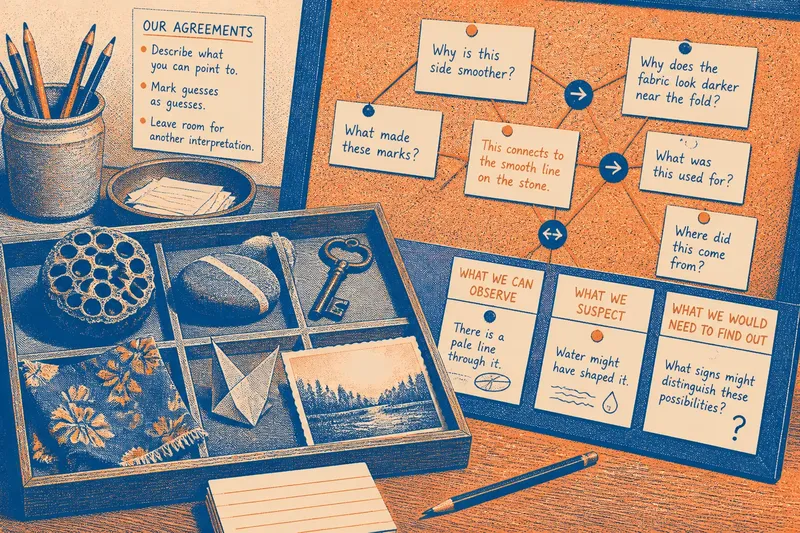
Post three agreements: describe what you can point to, mark guesses as guesses, and leave room for another interpretation. These reminders help participants distinguish visible details from possible explanations without demanding a single right answer.
- Check that an object is safe to handle; if it is sharp or fragile, then remove it, or show a drawing instead.
- Check that each object has a clear owner or source; if that is uncertain, then leave it out, or ask permission before displaying it.
- Check that a label states only known context; if it includes an unverified explanation, then revise it, or mark the claim clearly as a guess.
- Check that the surface is easy for the group to reach; if people cannot comfortably add cards, then move it, or provide a smaller board nearby.
- Check that blank cards and a pencil are available; if either is missing, then supply it, or set out another way to record questions.
- Check that the board has open space; if it is crowded, then cluster cards by object, or remove duplicate cards while keeping their ideas visible.
Notice first and sort later
On the first day, invite everyone to look quietly at the objects and choose one detail they had not noticed at first glance. “The stone has a pale line through it” gives other people something they can look for; “The stone is strange” does not point to a particular feature.
Write observations on small cards beside the relevant object, then invite one question per card. Keep the original wording where possible. “Why does the fabric look darker near the fold?” preserves a precise curiosity that a broad rewrite might lose.
Leave the questions unsorted at first. A mix of questions about origin, shape, purpose, and change can show how many routes one object opens. If the board gets crowded, group cards around each object without deciding which questions matter most.
Compare questions and revise the categories
On the second day, bring together questions that point toward the same feature. Questions about marks, texture, and wear might sit near an old key, even if the group does not agree about what made its marks.
On the third day, introduce temporary categories: “what we can observe,” “what we suspect,” and “what we would need to find out.” These labels separate a visible detail from an explanation, but they are working shelves, not permanent bins. Move a card when later discussion changes how it reads.
On the fourth day, invite participants to challenge the arrangement gently. A question may connect two objects or fit more than one category. Use string, arrows, or colored dots to show those links without removing the original cards.
Imagine a group has placed “Why is this side smoother?” beside a stone. One person suggests water shaped it; another notices that handling could also explain the smooth area. The group moves the card between “what we suspect” and “what we would need to find out,” then adds, “What signs might distinguish those possibilities?” The result is a visible record of competing ideas and the next question, not a verdict about the stone.
Add a prompt that connects to an existing one
On the fifth day, invite each participant to bring one prompt linked to something already on the board. It might be a sketch, a second object, a short description of a material’s source, or a question on a card. The aim is to extend a connection rather than pile up unrelated curiosities.
For instance, a leaf with a hole might prompt someone to bring a leaf with a different kind of edge. Put the two leaves together and ask what can be observed about the holes and edges, then note what remains unknown. Keep their questions side by side instead of forcing them into one explanation.
On the sixth day, invite participants to add links or revise labels. A card that begins “This connects to…” should name the observation behind the connection, so another person can see what prompted it.
What belongs on the board, and when should it change?
What belongs on a question board?
Include questions tied to something the group can see, handle, describe, or investigate later. A question can be playful or tentative, but it should give another person a place to begin looking.
Should a group add answers?
Yes, when the board can show how an answer was reached and what remains uncertain. Put a proposed explanation beside the question rather than covering it, so later visitors can still see what opened the inquiry.
How can participants disagree about a category?
Keep the question visible and connect it to more than one category if needed. The disagreement may show that people are noticing different features, which the group can record without resolving the placement immediately.
When should the objects be changed?
Replace an object when it no longer prompts new observations or when another object would create a useful comparison. Leave its question cards on the board so the group can see how its attention shifted after the object is gone.
Make the final arrangement readable to newcomers
On the final day, walk through the board together. Ask participants to choose a question that changed as it moved from observation to category or connection, then add a short note about what prompted the change.
Keep a few cards that show different kinds of movement: a detail that became a question, a question linked to another object, and a question that remains open. Photograph the arrangement if that suits the group, or leave the cards in place for people who missed the conversation. Return borrowed objects and mark which materials may stay out for the next round.
A question board is easier to join when its arrangement makes sense to someone who missed the original conversation. If an arrow or category depends on an unstated idea, add a brief note explaining the connection. For a cabinet of curiosities question board, that small note helps turn a private spark of interest into an invitation another person can follow.
Keep the objects ordinary, the cards movable, and the board open to revision. The group’s arrangement is not a final answer; it is a record of what people noticed together and a starting place for the next question.