What Makes a Question Worth Following?
Learn what makes a question worth following: give a shared exploration direction without shutting out surprising answers or useful detours.

A group is gathered around a kitchen table, watching a slice of apple turn brown while someone reaches for a lemon. “Why does fruit change color?” is a fine starting point, but it sprawls across many kinds of fruit, conditions and causes. “What changes when lemon juice touches a cut apple?” gives the group somewhere to look while leaving the answer open.
A question worth following has that balance: enough focus to guide attention, enough openness to let evidence or conversation change the direction. When a question stalls, wanders or seems to answer itself, the problem is often not a lack of curiosity. It is a mismatch between the question and the kind of exploration people can actually do together.
A question opens too many doors at once
“How does nature work?” invites nearly anything, which can make it hard for a group to choose what to notice first. Broad questions are useful for gathering interests, but they are awkward as a shared path: one person may want to talk about plants, another about weather, and a third about animal behavior.
Usually, the question contains several hidden questions. Give it a setting, an object or a comparison that people can return to. “What patterns do we notice in leaves from the same tree?” narrows the field without dictating what the pattern must mean.
Try adding one boundary at a time: a place, a material, a moment, or a contrast. Keep the boundary that helps people pay attention; drop any detail that merely makes the wording sound precise.
The wording points toward a preferred answer
“Why are bees better pollinators than flies?” quietly treats the comparison as settled. A group may spend its time defending or correcting the premise instead of noticing what each insect does around a flower.
This often happens when a question carries an assumption, a judgment or a proposed explanation inside it. Replace the verdict with something observable: “How do bees and flies behave differently around these flowers?” The new wording still gives the conversation a comparison, but it does not choose a winner in advance.
Scan for words such as “better,” “always,” “obviously” and “because.” They can be useful in a question about opinions or reasoning, but in an exploration they may smuggle in the conclusion. Ask what the group could observe, compare or discuss even if its first guess is wrong.
The question is so narrow that it has already answered itself
“Is this stone heavier than that one?” may be straightforward, but the answer arrives as soon as someone lifts them. That can be exactly the right question for a quick comparison. It is less useful if the group hopes to spend time exploring how stones differ.
A narrow question becomes more inviting when it asks what the observation might lead to. “What might explain why these stones feel different in the hand?” leaves room for shape, surface, density, moisture or other possibilities, without insisting that any one cause is correct.
Say you are comparing two smooth stones found beside a stream, and one feels heavier. You ask what features might account for the difference, then turn them over and notice that one is much thicker. That observation offers a possible direction, not a final verdict; the question has made room for another look.
A lively question cannot be explored with what the group has
Some questions are compelling in theory but poorly matched to the moment. “What makes a city feel welcoming?” may lead to a rich conversation, yet a group sitting together without any shared place, example or experience can struggle to begin.
The usual snag is not that the question is too ambitious. It lacks a common point of contact. Bring in something the group can examine or recall together: a map, a photograph, a familiar route, or a description of a particular public space. Then ask what features seem inviting, and what else people would need to know before drawing a wider conclusion.
If the question depends on information the group cannot access, make that limit visible and adjust the scope. A question can still be worth keeping for later; it does not have to be the next question followed.
The group keeps changing the subject
Unexpected connections can be productive, but a conversation that leaps from one interesting thought to another may leave no shared thread. One person follows a word, another follows an anecdote, and the original question disappears without anyone deciding to leave it.
Often the group has not distinguished a useful detour from a new topic. Pause and ask how the new idea connects to the question at hand. If the connection sharpens it, revise the wording together; if it opens a separate line worth pursuing, set it aside in a phrase so the group can return without having to chase it now.
A question is a direction, not a leash. Let the wording change when the group learns what it actually wants to notice.
How can you tell if a question is ready?
Does it give everyone the same starting point?
People should be able to tell what they are looking at, discussing or comparing, even if they expect different answers. If each person imagines a different subject, add a shared object, setting or situation.
Can more than one answer remain plausible?
An open question does not mean an unfocused one; it means the wording does not settle the result ahead of time. If only one answer seems permitted, replace the implied verdict with a question about what people can notice or explain.
Could an observation change what the group asks next?
A question worth following can respond to what turns up. If any possible observation would leave the wording and direction untouched, the question may be too general or detached from the exploration.
Does the question fit the time and materials at hand?
A question can be important and still not suit this shared session. Choose a version the group can begin with its available examples, experiences or materials, and keep the larger question for another time.
Keep the question open without letting it drift
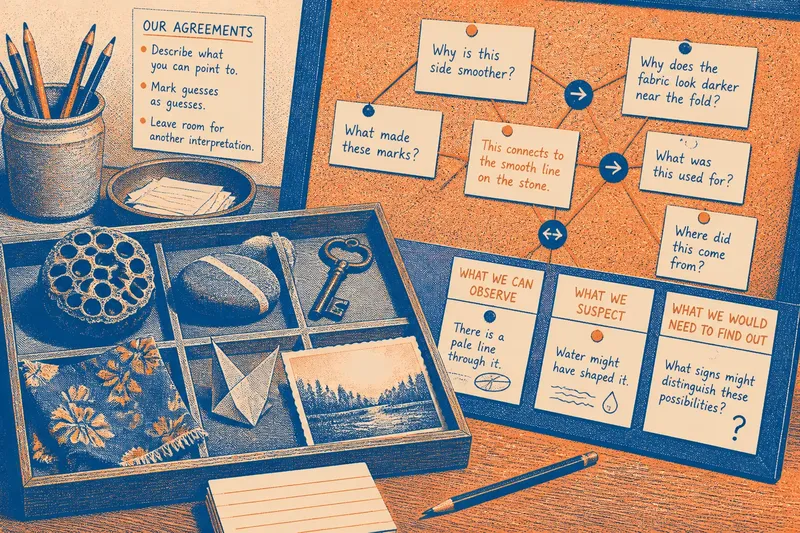
Before settling on a question, have each person say what they think it is asking and what kind of observation or idea might move the conversation. Differences in those replies reveal whether the wording is too broad, too leading or too private to one person’s assumptions.
Then make a small edit rather than starting over. Add a concrete subject, remove a presumed answer, or exchange a sweeping “why” for a question about what changes, differs or might explain an observation. The main search phrase, what makes a question worth following, comes down to this useful test: the question gives people something shared to pursue while leaving the result genuinely unsettled.
When the group reaches an answer that feels convincing, ask what it does not yet explain. That remaining edge is often the next good question—and a natural place to begin together another day.